

 Search
Search
Search
AMCA’s Three-Day Training Course for Arbitration and Mediation Professionals
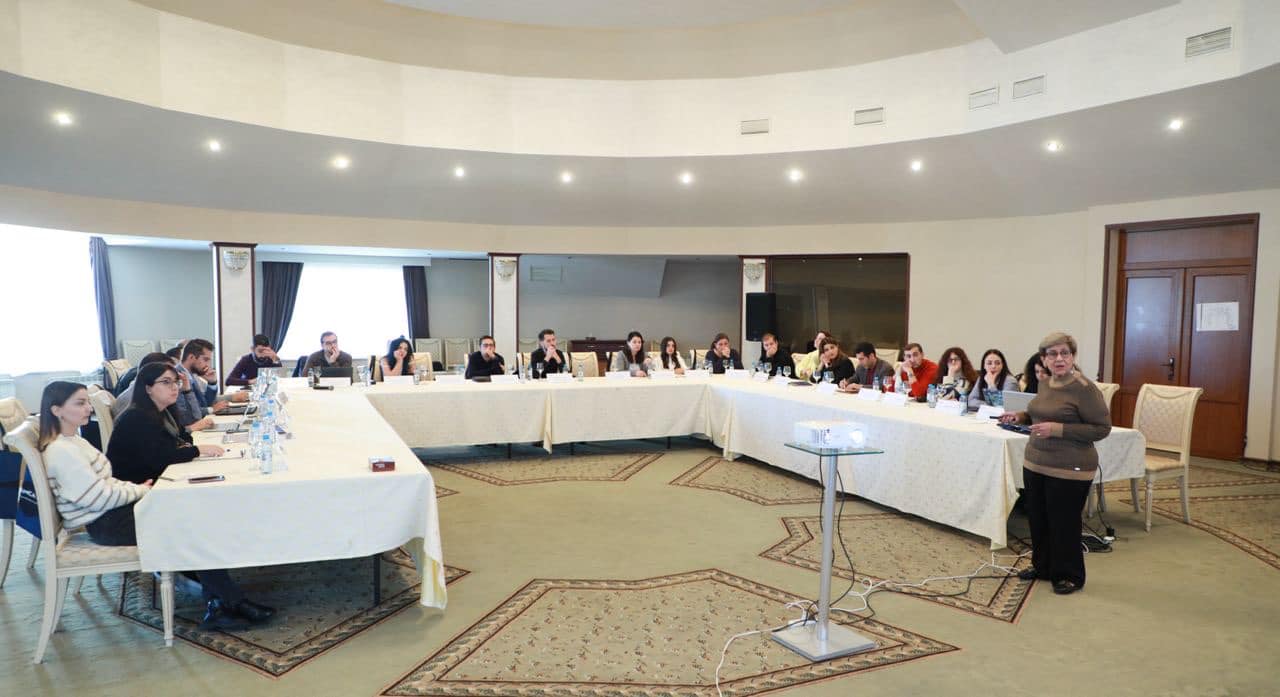
On December 1, the three-day training course launched by the Arbitration and Mediation Center of Armenia addressed a number of key issues related to the fields of arbitration and mediation. The course was organized for representatives of large and medium-sized businesses, banks, and lawyers, with the aim of presenting alternative dispute resolution mechanisms, the specific features of their application, and their practical significance.
On the first day of the course, Tatevik Matinyan, Director of the Arbitration and Mediation Center of Armenia, presented the Center, its role, and its functions. The participants introduced their companies, fields of activity, and experience with arbitration and mediation institutions. The discussion covered the Center’s activities, the efficiency and speed of dispute resolution, the requirements applicable to arbitrators and mediators, as well as the specific features of court proceedings. Among the issues of interest to the participants were also the Center’s role and expectations in the financial, business, and sports sectors.
The second day of the course was officially opened by Davit Gharibyan, Deputy Director of the Legislation Development Center Foundation, who spoke about the establishment, development, and role of the Arbitration and Mediation Center of Armenia. This was followed by a presentation by Hayk Hovhannisyan, Member of the Center’s Arbitration Council and Managing Partner of HAP Law Firm, on the topic “What is arbitration and what are its advantages?” He addressed the background of the formation and development of arbitration in the Republic of Armenia, the existing obstacles, and its advantages. He also highlighted the Center’s potential in the context of effective and professional dispute resolution. During the second day, Aida Avanesyan, Member of the Center’s Arbitration Council and Doctor of Law specializing in international law, delivered a presentation on the topic “Disputes Resolved through Arbitration.” She introduced the participants to the range of cases that may be examined through arbitration, distinguishing between international practice and local approaches. Issues relating to challenges to the jurisdiction of the arbitral tribunal, as well as the law applicable to questions of jurisdiction, were also discussed. Later that day, the series of presentations continued with Lilit Gabrielyan, representative of the Office of the Financial System Mediator, who spoke on the topic “Mediation and Its Advantages.” She presented the essence of mediation, its specific features, advantages, and types. Through the discussion of practical scenarios, participants were also introduced to the role of mediation and the procedure for its implementation.
On the third day of the course, Lilit Petrosyan, Deputy Director of the Center and PhD in Law, presented the arbitration rules of the Arbitration and Mediation Center of Armenia. She addressed the structure of the rules and the arbitral proceedings conducted on their basis, starting from the submission of a request for arbitration to the Center and ending with the rendering of an arbitral award. Issues relating to court assistance in arbitration were also discussed. The presentation was accompanied by numerous questions and a substantive discussion. Also on the third day, Hayk Kupelyants, Member of the Center’s Arbitration Council, PhD in Law, and Lecturer at King’s College London, delivered a presentation. Within the framework of the topic “Drafting Effective Arbitration Clauses,” he presented the specific features of institutional arbitration and referred to European, Asian, and American models and experience. The discussion also covered the drafting of effective arbitration agreements, their invalidity, and other related issues. The course became an important professional platform for participants to acquire new knowledge, exchange experience, and discuss practical issues arising in the fields of arbitration and mediation.